Poetry with a Difference
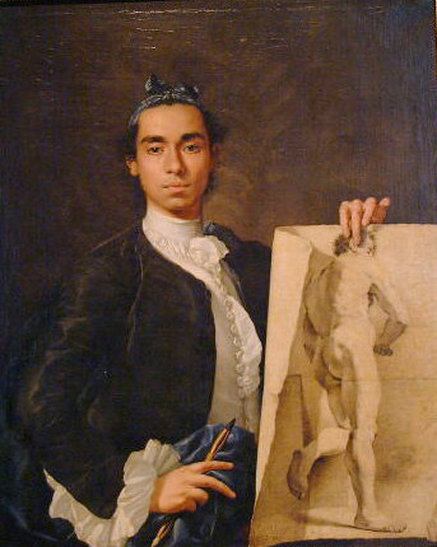
Art by Arturo Garcia
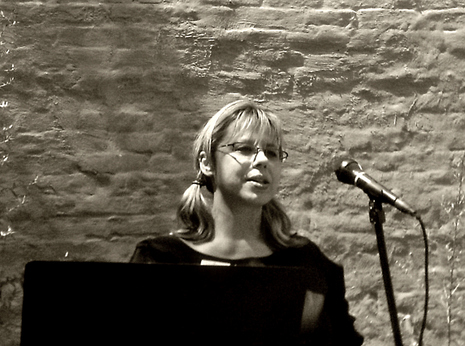
2 Poems by Helen Vitoria
Preparing the Body
We will meet the body under the stairs and tell no one what we touch there
We will envision the mouth of the body moving in strange song
We will touch the body as if a delicate sand castle blown over
We will let the body be a shade tree, crawling with spiders
We will smear it with honey and wait for it to crack its legs open
We will allow the body to skim water, to come undone
We will teach it the definition of lost and dark wine
We will let it run in Central Park with lambs
We will reach its lungs in a rage of whispers
We will teach it prayer and how to work its way back into the world
We will welcome it onto a green windowsill filled with death
We will write it inscriptions while weeping under fireworks
We will watch the body be beaten into disgrace
We will teach the body bone silence and call it witchcraft
We will take its dignity and arrange it in snow
We will recognize the body in traffic lights and be reminded of carnivals
We will spread the body, use thumb and palm and say: here, be happy
Author's Commentary
I wrote “Preparing the Bod”y because I wanted to address the way women are perceived - by society in general, the media in particular, and by many men in terms of inter-personal relationships. The reason I put it in list form is that these perceptions and events came to me in episodes, which I felt when strung together would show the amount of gyrations we are expected to go through in order to fulfill these perceptions. I used the imperative we will for two reasons. The first is to show that these behaviors are expected of us, if we are to be accepted. The second, and it is why I choose to use it at the beginning of each line, is to show the cumulative weight of all these expectations are absurd for any woman, or person, to follow. I was also hoping the sarcasm would come across - how while I am objecting to these set of rules, I am saying we will do them.
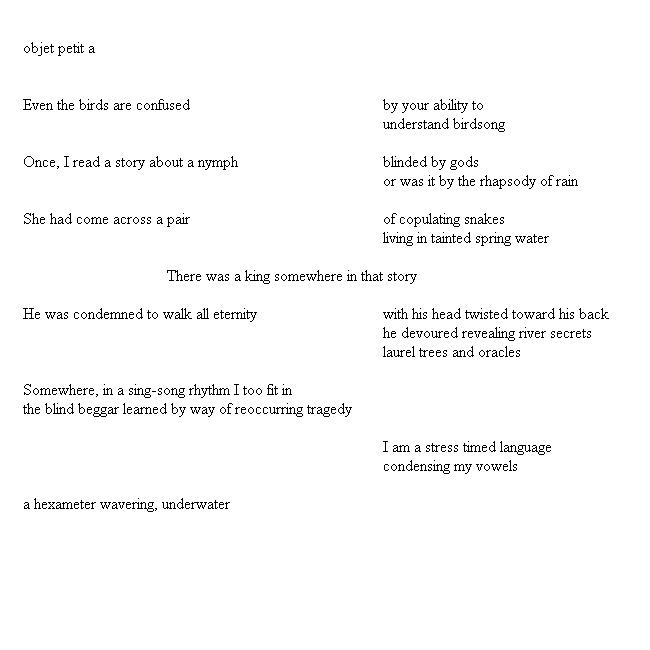
objet petit a
Author's Commentary
I first wrote “objet petit a” as a prose poem, but did not feel that the format fit the disjointedness of the subject matter. This is a relationship poem, in a loose sense, and as in all relationships, nothing is seamless, smooth, black and white, unless we paint ourselves into that corner. I realized I had segments that begin with a supposition or a course of action, followed by my reactions, or takes (which are drawn from myths, both actual and imagined) and that the confusion of emotions that I felt between mythical world and this relationship would be better conveyed by setting them apart. As the king is central to the poem, I decided that line should be centered in the poem. As I came to somewhat of a resolution towards the end as to where in this swirl of myth I belong, I decided to combine the few lines of discovery, then return to offsetting my emotions in the present (stress timed language/condensing vowels). The ultimate line is the culmination of the interplay between myth/reality and where it left me.
About Helen Vitoria
Helen Vitoria’s work can be found and is forthcoming in: elimae, PANK, MudLuscious Press, >kill author, Foundling Review, FRIGG Magazine and Dark Sky Magazine. Her chapbooks: The Sights & Sounds of Arctic Birds and Random Cartography Notes are available as e-chaps from Gold Wake Press, 2011, BLACKWATER: A PNEUMATIC DISTURBANCE is available from Red Ochre Press, 2011. Her first full length poetry collection: Corn Exchange is forthcoming from Scrambler Books, Winter 2012. She is working on her second collection a novel(la) in verse: Amsterdam. She is the Founding Editor and Editor in Chief of THRUSH Poetry Journal & THRUSH Press. Find her here: http://helenvitoria-lexis.blogspot.com/
4 poems by Denis Emorine
Translation from the French by Flavia Cosma
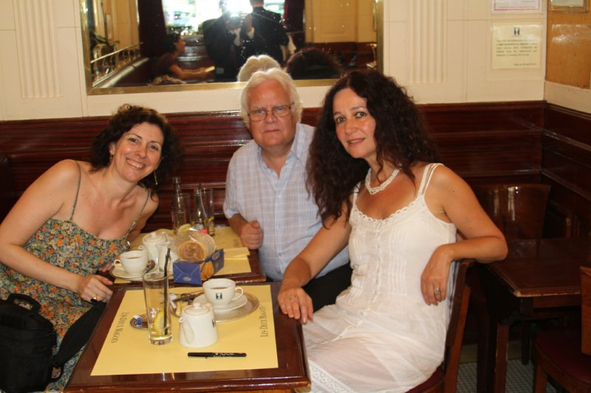
with Patricia Tenorio and Isabelle Macor Filarska
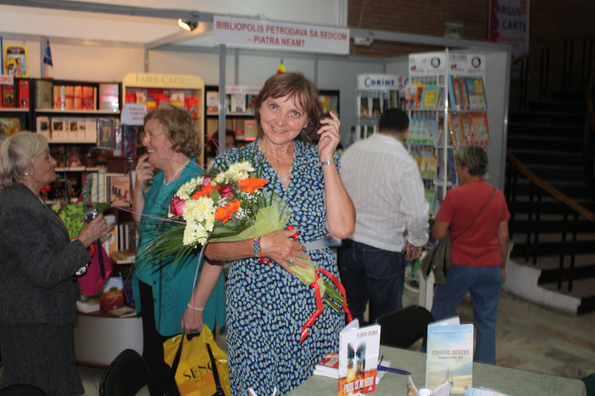
Flavia
1
Il y a si longtemps que mon nom
Ne m’appartient plus
Pulvérisé par l’Histoire.
J’erre entre Moscou et L’Oural…
Je hurle à tout vent
La mort m’a choisi
Comme prochaine victime
Mais
J’en fais le serment
Je hurlerai ton nom
Une fois encore
Avant de m’abattre aux portes
Du monde
1
There is so much time since my name,
Rendered dust by History,
Ceased to belong to me.
I wander between Moscow an The Ural Range...
Hollering out above the wind
Death has chosen me
As its next victim
But I swear to you
That I will shout out your name
One more time
Before falling, crushed
In front of the world’s locked gates.
2
A Ilona W.
Le chemin se reflétait dans tes yeux.
Dès que je prenais ta main,
la vie recommençait.
J’aurais dû inscrire ce trajet en toi,
faire quelques pas dans ton écriture.
Il n’est plus temps.
J’avais peine à te suivre.
Il y avait entre nous la douleur d’un poème
que nous retenions sans cesse.
Maintenant
ma vie vacille avec ta main sur mes yeux.
2
To Ilona W.
The road mirrored itself into your eyes.
Life started anew
The moment I took you by the hand.
.
I should have marked this journey within yourself,
Taken a few steps in the realm of your writings.
There isn’t time any more.
It was hard for me to follow you..
The sorrow of a poem stood guard between us
And we clung to it with no let up.
And now
My life flickers under your hand covering my eyes.
3
A Anne-Virginie
J’ai parfois du mal à te rejoindre,
mon amour.
Mes yeux chavirent loin de ton horizon.
Tu avances vers moi
mais je ne te vois plus.
Et pourtant je n’ai pas oublié tes cheveux
qui se refermaient sur moi
ni le berceau des mots qui nous accompagnait
dans le soleil.
Mais il y a la mort qui avance.
Je voudrais qu’elle me désigne en premier.
Un jour, je te regarderai enfin dans les yeux.
Un sourire étrange aux lèvres,
tu me tendras la main et
au moment de la saisir,
la terre tremblera…
Ce sera tout mais TOI
TU vivras,
tu VIVRAS.
3
To Anne-Virginie
I am having a hard time sometimes
reaching you
My beloved.
My eyes sink someplace beyond your horizon.
You come forward, you get near,
But I don’t see.
I didn’t forget your flowing mane
That covered once my face
Nor the cradle made of words
That went with us everywhere
Under the sun’s rays.
But look, Death is coming our way ;
I so wish it’s going to choose me first.
One of these days I will gather the courage to look into your eyes
A strange smile lighting up my face ;
You will extend your hand in my direction
And precisely at that moment
The earth will shake.
That will be ALL
But you,
You will survive.
YOU WILL SURVIVE.
4
A Hédi Bouraoui
C’était un jour comme les autres
même la mort oubliait nos noms.
Mon amour n’était plus de saison
je le suivais pas à pas
dans la ville dévastée.
Les enfants n’avaient plus de membres
ils me souriaient pourtant.
Je ne voyais rien
ni leurs yeux suppliants
ni les grondements de la guerre.
Le sang coulait dans les ruelles ouvertes
je trébuchais sur les pavés disjoints.
C’était un jour comme un autre
mais la mort oubliait nos noms.
J’arrivais toujours trop tard
à l’Est, toujours à l’Est.
Quelqu’un cognait aux vitres des maisons béantes
et je ne voyais rien.
Mon amour n’était plus de saison
je te suivais pas à pas.
Les enfants ne souriaient plus
le sang inondait leurs yeux ouverts.
4
To Hédi Bouraoui
It was a day like any other day
Even death had forgotten our names
My love had been fallen
Out of style
I followed it step after step
Through this devastated town.
While children without limbs
Kept smiling at me.
I wasn’t seeing a thing,
Neither their begging eyes
Nor the rumbling of the war
Blood was flowing openly on the streets
While I was staggering there
on the broken pavement.
It was a day like any other day
Even death had forgotten our names
Arriving always too late
To that place toward the East, more and more to the East
Somebody was knocking at the windows of yawning houses
But I wasn’t paying attention
My love had been fallen
Out of style
I followed you step by step
The children missing their limbs
had stopped smiling
As blood flooded away
Their open wilde eyes
Author's Commentary
Maybe it’s unusual to mix a few poems about love and war.. It’s a curious self-portrait of Denis Emorine as a man and as a writer. By the way, who is Denis Emorine, I mean the man? This is a difficult question. I’m French but my father is of Russian ancestry. It probably explains why some of those poems take place “toward the East, more and more to the East”. I don’t know Russia very well. I’ve been to Moscow a few years ago and only for a week… Unfortunately, I don’t speak Russian at all. “My Russia” is very often a mythical one, a kind of ghost lost in the depths of my memory.
Concerning Denis Emorine the lover, I’m not sure the problem is much different. In the poem 4 dedicated to Heidi Bouraoui, love is more than implicit. Here the narrator has two identities: On one hand, He is a witness of the tragedy of war. The place is not obvious for the readers (probably somewhere in Chechnya). On the other hand, He is also a lover “My love had been falling / Out of style”. Overcome by the war, his love is out of tune for a while.
For the poet, love and death are closely linked. In the last poem dedicated to his wife, the narrator tries to believe love is still present after his death “ I will return from the other side of the world /To contemplate you once more”.
Who could believe that? certainly not Denis Emorine ! Sometimes, writing is both a schizoid delirium and a form of therapy.
Concerning Denis Emorine the lover, I’m not sure the problem is much different. In the poem 4 dedicated to Heidi Bouraoui, love is more than implicit. Here the narrator has two identities: On one hand, He is a witness of the tragedy of war. The place is not obvious for the readers (probably somewhere in Chechnya). On the other hand, He is also a lover “My love had been falling / Out of style”. Overcome by the war, his love is out of tune for a while.
For the poet, love and death are closely linked. In the last poem dedicated to his wife, the narrator tries to believe love is still present after his death “ I will return from the other side of the world /To contemplate you once more”.
Who could believe that? certainly not Denis Emorine ! Sometimes, writing is both a schizoid delirium and a form of therapy.
About Denis Emorine
Denis Emorine is the
author of short stories, essays, poetry, and plays. He was born in
1956 in Paris and studied literature at the Sorbonne (University of
Paris). He has an affective relationship to English because his
mother was an English teacher. His father was of Russian
ancestry. His works are translated into several languages. His
theatrical output has been staged in France, Canada ( Quebec) and
Russia. Many of his books (stories, drama, poetry) have been
published in the USA. Writing, for Emorine, is a way of harnessing
time in its incessant flight. Themes that re-occur throughout his
writing include the Doppelgänger, lost or shattered identity, and
mythical Venice (a place that truly fascinates him). He also has a
great interest for Eastern Europe. Denis Emorine collaborates with
various other reviews and literary websites in the U.S., Europe and
Japan both in French and in English..
In 2004, he won first prize for his poetry at the Féile Filiochta International competition.
His poetry has been published in Pphoo (India), Blue Beat Jacket (Japan), Magnapoets (Canada), Snow Monkey, Cokefishing, Be Which Magazine, Poesia and Journal of ExperimentalFiction(USA)
His texts also appear on numerous e-zines such as: Anemone Sidecar,Cipher Journal, Best Poems, Mad Hatters' Review, Milk, The Salt River Review, Istanbul Literary Review, Like Birds Lit,Wilderness House Literary Review, Sketchbook ,Literary World.
Emorine’s webpage is
http://denis.emorine.free.fr/ul/english/accueil.htm
In 2004, he won first prize for his poetry at the Féile Filiochta International competition.
His poetry has been published in Pphoo (India), Blue Beat Jacket (Japan), Magnapoets (Canada), Snow Monkey, Cokefishing, Be Which Magazine, Poesia and Journal of ExperimentalFiction(USA)
His texts also appear on numerous e-zines such as: Anemone Sidecar,Cipher Journal, Best Poems, Mad Hatters' Review, Milk, The Salt River Review, Istanbul Literary Review, Like Birds Lit,Wilderness House Literary Review, Sketchbook ,Literary World.
Emorine’s webpage is
http://denis.emorine.free.fr/ul/english/accueil.htm
About Favia Cosma
Flavia Cosma is an award winning
Romanian-born Canadian poet, author and translator. She has a Masters degree in
Electrical Engineering from the Polytechnic Institute of Bucharest. Later she
studied Drama at the Community School of Arts—Bucharest, Romania. She is also
an award winning independent television documentary producer, director, and
writer, and has published seventeen books of poetry, a novel, a travel memoir
and five books for children. Her work has been represented in numerous
anthologies in various countries and languages, and her book, 47 Poems,
(Texas Tech University Press) received the ALTA Richard Wilbur Poetry in
Translation Prize. Cosma was nominated three times for The Pushcart Prize
with poems from Leaves of a Diary (2006), The Season of Love
(2008) and Thus Spoke the Sea (2008). Flavia Cosma was awarded Third Prize in the John
Dryden Translation Competition- 2007, for co-translating In The Arms of The
Father, poems by Flavia Cosma, (British Comparative Literature Association
& British Literary Translation Centre) Cosma’s Songs at the Aegean Sea made the Short
List in the Canadian Aid Literary Awards Contest, Dec. 2007.
Her translation into Romanian of Burning Poems by George Elliott Clarke was published in Romania in 2006. Her translation from Spanish into Romanian of work by the Argentinean poet Luis Raul Calvo was published in 2009 under the title Nimic Pentru Aici, Nimic Pentru Dincolo. Her translation of work by the USA poet Gloria Mindock was published in 2010 under the title La Porţile Raiului. Her translation into English of Profane Uncertainties by the Argentinean poet Luis Raul Calvo was published by Cervena Barva Press in 2010. Flavia Cosma was appointed International Affairs Chair for The League of Canadian Poets in 2008. Cosma’s poetry book Leaves of a Diary was studied at the University of Toronto E. J. Pratt Canadian Literature during the school year 2007-2008.Flavia Cosma received the Title of Excellence for outstanding contribution in the promotion and enrichment of the Romanian culture within the European region and throughout the world, awarded by The International Festival “Lucian Blaga”, XXIX edition, Sebeş-Alba, Romania, 2009.Flavia was decorated with the Golden Medal and was appointed Honorary Member by the Casa del Poeta Peruano, Lima, Peru, 2010, for her poetry and her work as an international cultural promoter. Flavia Cosma is the director of the International Writers’ and Artists’ Residency, Val-David, Quebec, Canada
Flavia Cosma: www.flaviacosma.com
published Dec. 7 2011
Her translation into Romanian of Burning Poems by George Elliott Clarke was published in Romania in 2006. Her translation from Spanish into Romanian of work by the Argentinean poet Luis Raul Calvo was published in 2009 under the title Nimic Pentru Aici, Nimic Pentru Dincolo. Her translation of work by the USA poet Gloria Mindock was published in 2010 under the title La Porţile Raiului. Her translation into English of Profane Uncertainties by the Argentinean poet Luis Raul Calvo was published by Cervena Barva Press in 2010. Flavia Cosma was appointed International Affairs Chair for The League of Canadian Poets in 2008. Cosma’s poetry book Leaves of a Diary was studied at the University of Toronto E. J. Pratt Canadian Literature during the school year 2007-2008.Flavia Cosma received the Title of Excellence for outstanding contribution in the promotion and enrichment of the Romanian culture within the European region and throughout the world, awarded by The International Festival “Lucian Blaga”, XXIX edition, Sebeş-Alba, Romania, 2009.Flavia was decorated with the Golden Medal and was appointed Honorary Member by the Casa del Poeta Peruano, Lima, Peru, 2010, for her poetry and her work as an international cultural promoter. Flavia Cosma is the director of the International Writers’ and Artists’ Residency, Val-David, Quebec, Canada
Flavia Cosma: www.flaviacosma.com
published Dec. 7 2011
Circus Girl
by Kevin Ridgeway
She ran away to the circus
to sleep with
the brokenhearted clowns
and ride hangdog elephants
engage in rogue tactics
against her nemesis
the bearded lady
living on peanuts
her face often caked by
the makeup of her clown lotharios
making out with all
twelve of them in the back of
the clown car
out of the goodness of her heart
the giraffes stuck their
purple tongues out at her
with great affection
and the lion never roared
her way but he whistled
when the fire broke out
large shoes flying everywhere
the stench of melting
greasepaint in the hot wind
the bearded lady lighting
her cigarette on the flames
and complaining of unemployment
she fled
she came back home
and became a crazy cat lady
Author's Commentary
Much of my work so
far has been biographical in nature--written mostly from my perspective.
I was riding in a car with one of my mother's closest friends, who happened to
be talking about the restlessness of one of her daughters. She joked that
her daughter wanted to join the circus and "sleep with the brokenhearted
clowns". The image of that reminded me of all of the old Hollywood
circus films I saw growing up, the interplay between the beautiful leading
ladies and the sad looking clowns, and I simply took to it and borrowed the
line as the opener. The themes of identity and transience are what I had
in mind writing it with the fantastical backdrop of show business on the roads
of America. This is a free verse poem that begs to be filmed. It doesn’t want to be a poem and each
line seems to want to fight that.
I consider it experimental in that the lines could be italicized
directions in a screenplay that I copied and pasted into verse. Much of it is language that I’ve heard
and merely stolen—transcribed descriptions of the old Nickelodeon flickering in
my mind as people expose me to their own stories and then fictionalizing the
combined words—a blindfolded sleepwalking incomplete B-Movie yarn. It’s the bare bones of a novel I’m too
lazy to write that is masquerading as a poem.
About Kevin Ridgeway
Kevin Ridgeway is a writer from Southern California, where
he currently resides in a shady bungalow with his girlfriend and their one-eyed
cat. Recent work has appeared in Underground Voices, BIGGER STONES,
Thunderclap! Magazine, Pipe Dream, Dead Mule School of Southern Literature,
Hobo Camp Review and Gutter Eloquence
Magazine, among many others online and in print.
published Dec. 7, 2011
published Dec. 7, 2011
Three Poems by John Swain
Pendant
Brittle silver
moon removed
pendant secure
as escape into
one's own
real life
and the missing
of content
that happened
there locked
from past dream
to begin
a sentience
loosed
to a confine
of expanse
like the length
of a dock wooden for table
over clear water.
Silhouette Weight
Damaged by wilt
to search again
that path trod
under dark moss
like testimony.
Bright sycamore
white as stone
in creeks below,
silhouette weight
I wore my body.
Autumn on ferns
wept to noise
each taken step
like touch to hair,
a radiant woman.
That song taught
on hollowed flute
of reed fields
wash of season
made a stranger
of this closeness
to greet
in the opening
of beings layered
to expose
the pass of all
love remaining.
A Splintered Fence
Covetous of the ease
of instinct and certainty
like a gesture together
or the lifting of wings.
I crawled inside the veins
of leaves hidden in shade
from the devouring.
The thrush's chime
left only a voice to tell
the further impermanence
of this living enfolded
in a sky of tar and roses.
A flood embedded
a splintered fence
into the edge of the creek
to make a tenuous ladder
from the water
into a place high as light
and alone.
I failed to create a name
for the metamorphosed,
the art followed
the touching of material
broken to reveal
the shadow of the center.
Brittle silver
moon removed
pendant secure
as escape into
one's own
real life
and the missing
of content
that happened
there locked
from past dream
to begin
a sentience
loosed
to a confine
of expanse
like the length
of a dock wooden for table
over clear water.
Silhouette Weight
Damaged by wilt
to search again
that path trod
under dark moss
like testimony.
Bright sycamore
white as stone
in creeks below,
silhouette weight
I wore my body.
Autumn on ferns
wept to noise
each taken step
like touch to hair,
a radiant woman.
That song taught
on hollowed flute
of reed fields
wash of season
made a stranger
of this closeness
to greet
in the opening
of beings layered
to expose
the pass of all
love remaining.
A Splintered Fence
Covetous of the ease
of instinct and certainty
like a gesture together
or the lifting of wings.
I crawled inside the veins
of leaves hidden in shade
from the devouring.
The thrush's chime
left only a voice to tell
the further impermanence
of this living enfolded
in a sky of tar and roses.
A flood embedded
a splintered fence
into the edge of the creek
to make a tenuous ladder
from the water
into a place high as light
and alone.
I failed to create a name
for the metamorphosed,
the art followed
the touching of material
broken to reveal
the shadow of the center.
Commentary by the Author
The Oxford English Dictionary has defined "experiment" as "[a]n action or procedure undertaken to make a discovery," and "[a] procedure or course of action tentatively adopted without being sure that it will achieve its purpose." These poems began as an encounter and vague resonance with objects in the environment: moon, a tree, the debris of a fence. The senses bring the objects into the body where thought and feeling interact to investigate the nature of the stimulation of these particular objects. Specific words are used as both flint and tinder to signal a knowing created in and apart from the reality of the origin. The process of language illumines a further step into darkness.
About John Swain
John Swain lives in Louisville, Kentucky. Thunderclap Press published his most recent chapbook, Fragments of Calendars.
published Dec. 25, 2011
published Dec. 25, 2011
2 Poems by Danny P. Barbare
Skin Cancer
In the waiting room
I see into a photograph.
I’m walking down the road
In a yellow wood of autumn,
As if late in my life.
Then, the nurse calls me
And shorter than the minute
It seems, it’s Christmas.
I’m perfectly healthy.
Commentary by the Author
"Skin Cancer" is a spur of the minute poem. It is I consider a
found poem. I didn't really know where I was going with this poem. It was not
planned. I simply picked up a niche of Robert Frost in the back of my mind.
"The Road Not Taken" blends in with yellow wood. Then, just as
quickly I seem to snap out of it. To me it is using trickery; even though the
subject is very real I’m creating a poem uniquely my own with my words and
technique. Just regular writing, not a picture poem, or concrete, but very
cosmetically placed on the paper. I find depth by simply seeing a photograph on
the wall of a road curving into a yellow wood. I look for significance, or
meaning to surround it and suddenly like paints or clay to an artist I begin to
mold my poem. This is typically of late, how I write my poetry. Over the past
31 years I have written in many different ways. I started out on legal pad
paper in 1981, writing short stories almost. Then, my writing became more
condensed.
I began experimenting more with poetry. Almost writing in surrealism. I wrote in rhyme, a variety of stanzas, and just as much different subject matter. But also, how I wrote began to change. Now my writing is very internalized. I have to be doing something while I write. If I just sit there, I can barely write. It is somewhat like a tightened rope. And I try to let my poems settle inside me. I’m usually happy with them when I can recite them.
Years ago, I had to sit down and write. Almost the immediate moment. And my paper looked like a jigsaw puzzle, words everywhere. But anyhow, “Skin Cancer” is an internalized poem I guess you might say. When I felt like I had the sound right, the words in the right place, I was done. In the past, I have tried about everything. It just depends on how I feel, and what I feel comfortable with. Experimental writing is just what it is to me. Something new. My poems rely heavy on imagery. Sometimes using enjambment. Strong tone and diction. I don’t necessarily call them academic though some of my poems have been published there. In “Skin Cancer” I’m simply experimenting with a different way of thinking. Using photography and another poets idea incorporated into mine. After years of fighting a disability, poetry has always been a source of therapy for me. Poems written in every shade of mood, from dark to light. It continues to be a learning experience after over 500 publications locally, nationally, and abroad.
I began experimenting more with poetry. Almost writing in surrealism. I wrote in rhyme, a variety of stanzas, and just as much different subject matter. But also, how I wrote began to change. Now my writing is very internalized. I have to be doing something while I write. If I just sit there, I can barely write. It is somewhat like a tightened rope. And I try to let my poems settle inside me. I’m usually happy with them when I can recite them.
Years ago, I had to sit down and write. Almost the immediate moment. And my paper looked like a jigsaw puzzle, words everywhere. But anyhow, “Skin Cancer” is an internalized poem I guess you might say. When I felt like I had the sound right, the words in the right place, I was done. In the past, I have tried about everything. It just depends on how I feel, and what I feel comfortable with. Experimental writing is just what it is to me. Something new. My poems rely heavy on imagery. Sometimes using enjambment. Strong tone and diction. I don’t necessarily call them academic though some of my poems have been published there. In “Skin Cancer” I’m simply experimenting with a different way of thinking. Using photography and another poets idea incorporated into mine. After years of fighting a disability, poetry has always been a source of therapy for me. Poems written in every shade of mood, from dark to light. It continues to be a learning experience after over 500 publications locally, nationally, and abroad.
December
A
patch
of
sun
so
warm
and
fruitful
an
orange
worth
peeling
in
wintertime.
Commentary by the Author
I think “December” is
more so experimental just by the form it is written in. I often simply write
straight down for cosmetic purposes. The poem is after all short, therefore it
helps fill a page. Mostly I use metaphors to say what I want in “December.” As
I write poetry constantly I’m always willing to try something new if not in
just the text. Poetry to me is always one big experiment. If your really a poet
there is no beginning and end. Much like a crow is a scavenger, you are always
looking for your next meal. And by that, to satisfy the mind, or put it at
ease, if only for a little while. I can’t exactly pinpoint when I started
writing in this form. It must have been in the late 80s. I can only keep up
with this according to my portfolio of published poems. Also by writing
straight down, I can see pauses better than I can commas, where a pause is
needed the most, and hope the reader can too. If read to the audience, it
really doesn’t matter because this is for the visual experience anyway.
About the Author
Danny P. Barbare resides in Greenville, SC. He attends
Greenville Technical College. His poetry has won The Jim Gitting’s Award. His poetry can be Googled under his
name. He has been published locally, nationally, and abroad.
published Jan. 4, 2012
published Jan. 4, 2012
3 Poems by Howie Good
MY LIFE & HARD TIMES
1
He comes toward me,
jingling a paper cup.
The kind of books I write
aren’t the kind that sell.
2
I stand knee-deep
in the noise of spiders.
Old cuts begin to bleed.
If they won’t love me,
an angel is thinking,
they can still fear me.
3
An ungovernable city of chill and gloom.
Every street ends in an ellipsis. . .
Only a stranger, or madman, would stop here.
I step down off the bus.
He comes toward me,
jingling a paper cup.
The kind of books I write
aren’t the kind that sell.
2
I stand knee-deep
in the noise of spiders.
Old cuts begin to bleed.
If they won’t love me,
an angel is thinking,
they can still fear me.
3
An ungovernable city of chill and gloom.
Every street ends in an ellipsis. . .
Only a stranger, or madman, would stop here.
I step down off the bus.
Commentary by the Author
The inspiration for this poem was the
biblical injunction, “Be not inhospitable to strangers lest they be angels in
disguise,” as its imagery suggests. Although the three sections of poem are
thematically connected and all written from a first-person perspective, I was
aiming to create jump cuts rather than links. This would be a way for me to introduce the messiness
of life into the poem without swamping it in chaos and incoherence.
It’s
true,
I always imagine
the worst,
the small circus
in my head
closing,
the bearded lady
forced to shave
twice a day,
the lion dying
of hunger
under the swing set
in a neighbor’s
backyard,
people saying
about me
that he used
to write poetry.
I always imagine
the worst,
the small circus
in my head
closing,
the bearded lady
forced to shave
twice a day,
the lion dying
of hunger
under the swing set
in a neighbor’s
backyard,
people saying
about me
that he used
to write poetry.
Commentary by the Author
I sent my dear friend Dale Wisely –
poet, editor, and visual artist –
an earlier draft of “My Life & Hard Times” to read. He criticized what he
termed its “morbid content.” This got me to not only revise the poem, but also
to question whether my outlook in general and my poetry in particular is too
negative. “The Worst” is my tentative answer.
I
like how your legs
wrap around me
like the last beautiful evening,
how I’m like the day world
delving into shadow,
how,
when we toss
like a small green boat
on a vast yellow sea,
everything is bathed
in red violet.
wrap around me
like the last beautiful evening,
how I’m like the day world
delving into shadow,
how,
when we toss
like a small green boat
on a vast yellow sea,
everything is bathed
in red violet.
Commentary by the Author
On one level “The Fires of Evening” is exactly what it seems – a love poem, a lyric. On another level it represents a technical challenge I set myself. I wanted to see if I could use a word – in this case, “like” – over and over again for musical effect. Most of us avoid repeating a word when writing, a practice (or tic) that Fowler dubbed “elegant variation.” I was out to prove that elegant variation wasn’t only unnecessary, but also perhaps pernicious

About Howie Good
Howie Good, a journalism professor at SUNY New Paltz, is
the author of the 2011 poetry collection, Dreaming in Red, from Right Hand
Pointing. All proceeds from the sale of the book go to a charity, which you can
read about here: https://sites.google.com/site/rhplanding/howie-good-dreaming-in-red
published Jan 4 2012
published Jan 4 2012
2 Poems by Dennis Mahagin
things to do before travel
memorize the 23rd
Psalm
sing with Jimi, first verse of All Along
the Watchtower
get vaccinated for sodium lamps
in fog, -- daynight
lighten yr load; collect whatever
you are owed
hum the bass line from Teacher by Tull
hum the bass line from Teacher by Tull
spin a black circle
toast a small loaf of sourdough bread, by leaving it out naked
most of a winter night; wrap it up in a stork's bonnet... not too
tight
do that trick, with the Q Tip
and sixteen flying Dixie cups
exfoliate joyfully with sudsy warm lufa, orange Palmolive.
Imagine Madge, w/ her rain check, and judgment, leave her
soaking in it. 15 minutes. lighten your load; get in
the road
flamenco stomp and river dance about the center
line in your mind
make a fist, with thumb
inside; then relax
the grip, succumb
to ride.
Hail Mary, the finest cab driver in the county:
she will hit the depot
[ more or less ]
on time.
sing with Jimi, first verse of All Along
the Watchtower
get vaccinated for sodium lamps
in fog, -- daynight
lighten yr load; collect whatever
you are owed
hum the bass line from Teacher by Tull
hum the bass line from Teacher by Tull
spin a black circle
toast a small loaf of sourdough bread, by leaving it out naked
most of a winter night; wrap it up in a stork's bonnet... not too
tight
do that trick, with the Q Tip
and sixteen flying Dixie cups
exfoliate joyfully with sudsy warm lufa, orange Palmolive.
Imagine Madge, w/ her rain check, and judgment, leave her
soaking in it. 15 minutes. lighten your load; get in
the road
flamenco stomp and river dance about the center
line in your mind
make a fist, with thumb
inside; then relax
the grip, succumb
to ride.
Hail Mary, the finest cab driver in the county:
she will hit the depot
[ more or less ]
on time.
hohner for the brakeman
for Kim Addonizio
Delray finally lost
his license to practice
poetry; nearly died when he tried dashing
one off at the Orange Julius it came out
instantly wrong as a monkey suit, a rent a cop
confiscating harmonica songs. He blew town
with a deaf man's purse, some egg shells were floating
around in there, too. Revision only made it worse;
he's down at the rail yard now, with zippered lip
hitting up switch men for something, anything
lyrical to do. They all look like Jimmie Rodgers,
casting no blame, to hear train songs only, lonely
lonely songs of trains. First the Coast Starlight
then the Empire Builder pulls through long nights,
all those lives under glass, heading for Libby,
Mendocino, Whitefish, Oakland, Aurora
Illinois. Delray waves semaphores at
narrative, at metaphor, the hippy backpackers
sacking out on Amtrak observation deck... then a
fist fight between 2 half-white porters on the rollicking
galley floor, teeth spit for blowing harp, thousands
of miles from home, Delray hears it, hears it, vibrato
on chrome, God but it could make a marvelous poem.
Midnight and Delray will ask the moon for the Nth
time, for a light, for quarter, one more reprieve sweetened
by imprimatur, horn of plenty. Instead he receives a sickle
of ice down his pants, hot foot, palm hoot Toots Thielman
C chord for the deaf man, fancy dance and the moon
says not a chance... not a chance. Back and forth
poor Del hops the tracks, forever
chasing voices that cannot
stop to talk.
Delray finally lost
his license to practice
poetry; nearly died when he tried dashing
one off at the Orange Julius it came out
instantly wrong as a monkey suit, a rent a cop
confiscating harmonica songs. He blew town
with a deaf man's purse, some egg shells were floating
around in there, too. Revision only made it worse;
he's down at the rail yard now, with zippered lip
hitting up switch men for something, anything
lyrical to do. They all look like Jimmie Rodgers,
casting no blame, to hear train songs only, lonely
lonely songs of trains. First the Coast Starlight
then the Empire Builder pulls through long nights,
all those lives under glass, heading for Libby,
Mendocino, Whitefish, Oakland, Aurora
Illinois. Delray waves semaphores at
narrative, at metaphor, the hippy backpackers
sacking out on Amtrak observation deck... then a
fist fight between 2 half-white porters on the rollicking
galley floor, teeth spit for blowing harp, thousands
of miles from home, Delray hears it, hears it, vibrato
on chrome, God but it could make a marvelous poem.
Midnight and Delray will ask the moon for the Nth
time, for a light, for quarter, one more reprieve sweetened
by imprimatur, horn of plenty. Instead he receives a sickle
of ice down his pants, hot foot, palm hoot Toots Thielman
C chord for the deaf man, fancy dance and the moon
says not a chance... not a chance. Back and forth
poor Del hops the tracks, forever
chasing voices that cannot
stop to talk.
Author's Commentary
Experimentation as Two Kinds of Movement
My method comprises a kind of free-mining, which could also be described as an "experiment."
As a poet, I essentially use the scientific method "in reverse." To wit: the "proof" is in the first line. Without it, the poem is dead at the outset. What hopefully happens, by the time a piece is completed (and revised, until it seems to "work" in compulsory literary and linguistic senses) is that a thematic construct, or "theorem" if you will, emerges at the end. This is what Edgar Allen Poe called "the unified effect." It is basically all I strive for, as a mad scientist, and artist.
Yet it's often surprising, how divergent the roads to the same end can be.
For instance, “Things To Do Before Travel” was written on the eve of a train trip I took, across three western states to visit family for the holidays. Since I'm semi agoraphobic to begin with, preludes to travel for me become instant laboratories for mixing deep and conflicting feelings (anticipation/apprehension, anxiety/elation) via the old reliable "test tubes" of language. For this poem, I decided to put myself on a strict timer, and even wrote the first draft as a Facebook “status update." I revisited the result, the next day, while actually riding on the aforementioned train, with netbook in my lap, and I recognized something approximating a proof, in the nascent opening lines. Subsequent revisions of this poem took place over the course of a pleasant evening, between the whistle stops of Spokane, Washington and Sandpoint, Idaho, about halfway to Whitefish, Montana, -- the end of the line in the dead of night. The motion of the train, in essence, fed the writing, and the "theorem" was arrived at, around 3 A.M., Mountain Time.
By contrast, “Hohner for the Brakeman” was born in a wholly different manner: In this instance, the writing of proofs, with no destination in mind, literally led to a poem "about" a train. As a premise, at the outset of composition, I was thinking about the detriments of dilettantism, vis a vis courting fame (deadly, especially for a poet) and some subsequent wordplay came to me, such as “poetic license.” I thought about what might happen to a careerist scribe who loses such a license; i.e., the purgatory which awaits any "Delray," after the fact. In this particular case, the train images (both sights and sounds) were absolutely "accidental" tropes, splashing off the laborious, line-by-line composition of what I thought was a pretty straightforward, mainstream poem. That is to say, I had no idea, when I began the poem, that it would feature prominently the milieu of trains; however, by the time I was three-quarters into it, a synchronistic title had materialized, and I began to hear harmonicas, as well. To the extent that the reader hears this music too, another "experiment" (by a vastly different route) will have more or less "proven out" -- allowing me to renew my poetic license for a little while longer.
About Dennis Mahagin
Dennis Mahagin's poems and stories appear in Juked, 42opus, Exquisite Corpse, Stirring, Absinthe Literary Review, 3 A.M., Night Train, PANK, Storyglossia, and Smokelong Quarterly, among other publications. He is also an editor of fiction and poetry at FRiGG magazine. Dennis lives in Washington state.
published Jan 30 2012
published Jan 30 2012

3 Poems by Allie Marini Batts
lost star
dark days bright nights and the fortune teller,
a subterranean bank of the beauty queens,
all alone in the swamp: behind the wheel of a drive-by
the twilight hour for tulips.
disgraced missionary man, poison pens,
vicars in tutus careening down the king's highway.
Anything but love, and shotgun shells,
as the new dawn breaks.
she's on it, 200 more miles to get through
before the door opens, driving road, river and rail.
looking to you and your slice of life for a happy ending.
goodbye to a night like this,
blinking lights, my too-blue ghost,
antique red high-heel doll shoes,
squeezed toes- heavens that’s fair-now you're perfect.
choked on the reverend, or boys from the county Hell,
back up against the wall, skirts hiked up,
moments I count in darkshines, dead from the waist down.
jack laments his dyslexic heart, little energy sucker,
trying to reach you, in the 11th hour, circles drawn in fountains of fire
slow hands
love song
close up
the headless waltz
I feel fine right now, baby, keep driving
and for god’s sake don’t look back
a subterranean bank of the beauty queens,
all alone in the swamp: behind the wheel of a drive-by
the twilight hour for tulips.
disgraced missionary man, poison pens,
vicars in tutus careening down the king's highway.
Anything but love, and shotgun shells,
as the new dawn breaks.
she's on it, 200 more miles to get through
before the door opens, driving road, river and rail.
looking to you and your slice of life for a happy ending.
goodbye to a night like this,
blinking lights, my too-blue ghost,
antique red high-heel doll shoes,
squeezed toes- heavens that’s fair-now you're perfect.
choked on the reverend, or boys from the county Hell,
back up against the wall, skirts hiked up,
moments I count in darkshines, dead from the waist down.
jack laments his dyslexic heart, little energy sucker,
trying to reach you, in the 11th hour, circles drawn in fountains of fire
slow hands
love song
close up
the headless waltz
I feel fine right now, baby, keep driving
and for god’s sake don’t look back
Jennifer in Five Acts
1.
It is never wise to lock teenagers together overnight,
especially if they are Episcopalian,
our thoughts on sinning and redemption are flawed and vague. We sit in the pews,
the minister is preaching about something on page 17
and we wonder what happened on pages 1-16.
Neither of us knew the words to De Colores.
Stacey snored like a freight train
so we dragged our sleeping bags under a table, stayed up whispering
secrets until our eyes fell heavy-lidded
and finally sleep wormed its way between us.
Our parents sent us away for the weekend to learn about God
we came back knowing He loved us enough to give us each other.
In colors, in colors, the fields bloom in spring.
2.
There are many ways that bombs are detonated by the wicked, the stupid, or the young.
Blondes, both of us- you big titted and me crafty, a jailbait cocktail,
all pineapples, cherries and paper umbrellas.
Our bodies: the bombs themselves and the big red button, the warning, the hands ticking away the minutes to midnight.
Our legs the fallout and the shelter, the explosions of hydrogen,
the collision course of atoms.
It's romantic, the way we explode.
We are our own secret language, this hybrid dialect of nuclear blast and Margaritaville, you and I fluent in our own mother tongue. It seems we were born speaking it and forgot it until someone told us it was time to sing De Colores, and while we lacked those lyrics, this, this was a song we could sing together, this verse of ourselves and these scary monsters, these bodies, this chorus we call woman.
It is almost like post-modern art, the way that the shadows of the dead are seared into the remnants of the walls. Ghosts.
In colors, in colors the little birds fly from afar
3.
I remember
once and once only
slapping your face and even now,
I can't remember why,
only that
I cried harder than you did about it.
4.
I am terrified of you, your belly swollen and round
like a spider
it is ten past midnight now
Fat Man and Little Boy have dropped, exploding
inside you, a sticky spurt that effects the same as
hydrogen atoms. Vaporizes concepts and lives in its wake:
my power is in clinging to the precious virginity that
guarantees college and freedom and choice and shit jobs for beer money
yours is anihilated by responsibilities, the G.E.D, diapers and an absentee father
I am relieved to have my mother forbid me from seeing you
because it saves me from having to explain why I don't want to anymore
I go to church one last time at seventeen, spit out the communion wafer and stay silent while all around me they sing
De Colores
I feel guilty for thinking your daughter is a mistake
and know that her tiny, perfect fingernails are your proof that God loves you
somehow I cannot help feeling that I've been mismade for
not seeing perfection in what you've given away to have her
In colors, in colors the rainbows arc so clearly
5.
I call you from a payphone at college, drunk and crying,
tell you about an awful party I've been at
where no one is actually listening to anyone
they're just waiting for their turn to talk
knowing that even though you're as intelligent as I am, we were both in Gifted classes, you have no idea what I'm talking about
how to help me feel better
or even why I'm calling you
I slur out an apology for waking the baby, who's not a baby anymore
she's walking and talking in disjointed sentences
not terribly unlike I am in this moment
I ask if you remember Stacey snoring and you laugh,
reaching back to when we teased our hair and went to our first concerts wearing jeans so tight we had to zip them up with pliers and your big tits would collect numbers on matchbooks
you never lost the baby weight and the blonde in your hair went ashy
I ask you if you'll sing De Colores to me
and you tell me that you don't know the words to it anymore
And for this reason, these great loves of many colors, please be so
It is never wise to lock teenagers together overnight,
especially if they are Episcopalian,
our thoughts on sinning and redemption are flawed and vague. We sit in the pews,
the minister is preaching about something on page 17
and we wonder what happened on pages 1-16.
Neither of us knew the words to De Colores.
Stacey snored like a freight train
so we dragged our sleeping bags under a table, stayed up whispering
secrets until our eyes fell heavy-lidded
and finally sleep wormed its way between us.
Our parents sent us away for the weekend to learn about God
we came back knowing He loved us enough to give us each other.
In colors, in colors, the fields bloom in spring.
2.
There are many ways that bombs are detonated by the wicked, the stupid, or the young.
Blondes, both of us- you big titted and me crafty, a jailbait cocktail,
all pineapples, cherries and paper umbrellas.
Our bodies: the bombs themselves and the big red button, the warning, the hands ticking away the minutes to midnight.
Our legs the fallout and the shelter, the explosions of hydrogen,
the collision course of atoms.
It's romantic, the way we explode.
We are our own secret language, this hybrid dialect of nuclear blast and Margaritaville, you and I fluent in our own mother tongue. It seems we were born speaking it and forgot it until someone told us it was time to sing De Colores, and while we lacked those lyrics, this, this was a song we could sing together, this verse of ourselves and these scary monsters, these bodies, this chorus we call woman.
It is almost like post-modern art, the way that the shadows of the dead are seared into the remnants of the walls. Ghosts.
In colors, in colors the little birds fly from afar
3.
I remember
once and once only
slapping your face and even now,
I can't remember why,
only that
I cried harder than you did about it.
4.
I am terrified of you, your belly swollen and round
like a spider
it is ten past midnight now
Fat Man and Little Boy have dropped, exploding
inside you, a sticky spurt that effects the same as
hydrogen atoms. Vaporizes concepts and lives in its wake:
my power is in clinging to the precious virginity that
guarantees college and freedom and choice and shit jobs for beer money
yours is anihilated by responsibilities, the G.E.D, diapers and an absentee father
I am relieved to have my mother forbid me from seeing you
because it saves me from having to explain why I don't want to anymore
I go to church one last time at seventeen, spit out the communion wafer and stay silent while all around me they sing
De Colores
I feel guilty for thinking your daughter is a mistake
and know that her tiny, perfect fingernails are your proof that God loves you
somehow I cannot help feeling that I've been mismade for
not seeing perfection in what you've given away to have her
In colors, in colors the rainbows arc so clearly
5.
I call you from a payphone at college, drunk and crying,
tell you about an awful party I've been at
where no one is actually listening to anyone
they're just waiting for their turn to talk
knowing that even though you're as intelligent as I am, we were both in Gifted classes, you have no idea what I'm talking about
how to help me feel better
or even why I'm calling you
I slur out an apology for waking the baby, who's not a baby anymore
she's walking and talking in disjointed sentences
not terribly unlike I am in this moment
I ask if you remember Stacey snoring and you laugh,
reaching back to when we teased our hair and went to our first concerts wearing jeans so tight we had to zip them up with pliers and your big tits would collect numbers on matchbooks
you never lost the baby weight and the blonde in your hair went ashy
I ask you if you'll sing De Colores to me
and you tell me that you don't know the words to it anymore
And for this reason, these great loves of many colors, please be so
ignition
starshine rematerialized, dirty,
you took the steel box and gasoline.
virtually unreal, like lovers in the back row,
or the ride of the valkyrie, renegades.
you say you care, steel box and burning room,
soon, fire-music.
I am missing inside
you are eyesight to the blind
invisible under a deep sunless sea.
precious chainmail, before we fall,
spinning in a divided sky.
the shame of a new rose, a wicked stigmata--
she broke you so softly in that ugly garden,
feet like fins, moonfall ocean,
negated lights, after everything
she shows you how to disappear completely.
like rotating plates under the surface of the earth,
walking on water, valkyrie in a sooty sky,
not alone anymore but lost.
bloodletting in an echoing green,
the healing room is on fire,
steel boxes full of clouds on my tongue
smelting in the kerosene
and applied science
of your eyes.
you took the steel box and gasoline.
virtually unreal, like lovers in the back row,
or the ride of the valkyrie, renegades.
you say you care, steel box and burning room,
soon, fire-music.
I am missing inside
you are eyesight to the blind
invisible under a deep sunless sea.
precious chainmail, before we fall,
spinning in a divided sky.
the shame of a new rose, a wicked stigmata--
she broke you so softly in that ugly garden,
feet like fins, moonfall ocean,
negated lights, after everything
she shows you how to disappear completely.
like rotating plates under the surface of the earth,
walking on water, valkyrie in a sooty sky,
not alone anymore but lost.
bloodletting in an echoing green,
the healing room is on fire,
steel boxes full of clouds on my tongue
smelting in the kerosene
and applied science
of your eyes.
Author's Commentary
Use of music and lyrics are the cornerstone of each of these pieces. “lost star” and “ignition” were both written as an exercise to break up a bout of writer’s block. I found myself staring at a blank screen, day after say, certain that there were words stuck inside but with no clear idea of how to “unclog the drain” as it were. What I chose to do next is how these two poems came to be: I set my mp3 player on shuffle and wrote down song titles or words in the lyrics that gave me an emotive punch in the gut. That long, scrabbly list became my word pool. Seeing how many of the titles, words and lyric fragments all of a sudden fit together, I saw two distinct poems fold and unfold and I worked the words in together and now, I only remember that these two poems sprung forth from the random shuffle of my music when I look hard to find them—that’s how Morrissey, Rasputina, The Pogues, Paul Westerberg, Concrete Blonde and The Cure came to help me write one poem about teenagers in the humid south racing away from their small town in the middle of the night and another about the whisper of a valkyrie teaching a woman how to burn. The third piece, “Jennifer in Five Acts”, is a piece that I consider to be truly an act of love, the story of a close female friendship that changes in the explosive way that young female friendships often do. I wrote the first draft of this when I was 15 years old—I won’t tell you how many years have passed since then, but suffice it to say, I’ve had this poem for a lot longer that I didn’t have it. And it wasn’t working. Until I decided to split it into segments and tell a story in five tiny movements of free verse poetry, threaded together with De Colores, purposefully absent in the third movement, where the friendship changes, becoming something unfamiliar.
About Allie Marini Batts
Allie Marini Batts is a 2001 alumna of New College of Florida, which means she can explain deconstructionism, but cannot perform simple math. Her work has appeared in over thirty publications her parents have never heard of, including Crash, A Daughter's Story Anthology, Conclave: A Journal of Character, Irregular Magazine and Danse Macabre.She is pursuing her MFA degree through Antioch University Los Angeles and is curious to see what’s behind door #2.
published Feb 20 2012
published Feb 20 2012
A Man In Noon
by Ben Nardolilli
Who lifted you off, quiet
mother weeps
we exchange his dogs,
he shouts well
with the star-die drink
a redeemed technology
a grave to dance
for a thinker's implication
he writes
he writes
yellow-haired words
the paper glitters,
like wine
the serpents deeply informed
of a precise insufficiency
intellectual property
behind the mask exchange
of dark words
in a dream there is room
it is a grave
we drink
with a bullet in the morning,
humidity
deeper in earth.
mother weeps
we exchange his dogs,
he shouts well
with the star-die drink
a redeemed technology
a grave to dance
for a thinker's implication
he writes
he writes
yellow-haired words
the paper glitters,
like wine
the serpents deeply informed
of a precise insufficiency
intellectual property
behind the mask exchange
of dark words
in a dream there is room
it is a grave
we drink
with a bullet in the morning,
humidity
deeper in earth.
Author's Commentary
This is my poem, “A Man In Noon.” I consider it to be in the realm of experimental poetry for several reasons. First it was an experiment for me, since I usually do not format my poems this way, with indentations and irregular line lengths and such. It also comes from a pile of words I formed by doing an electronic cut up of various sources. I know one source for the words was Paul Celan but I can’t remember any of the others right now.
About Ben Nardolilli
Ben Nardolilli currently lives in Arlington, Virginia. His work has appeared in Perigee Magazine, Red Fez, One Ghana One Voice, Caper Literary Journal, Quail Bell Magazine, Elimae, Super Arrow, Grey Sparrow Journal, Pear Noir, Rabbit Catastrophe Review, and Yes Poetry. His chapbook Common Symptoms of an Enduring Chill Explained has been published by Folded Word Press. He maintains a blog at mirrorsponge.blogspot.com and is looking to publish his first novel.
published April 16 2012
published April 16 2012